Shops and Resources in Flamecraft
Every turn is a new shop—know the goods before you pay the table tax.
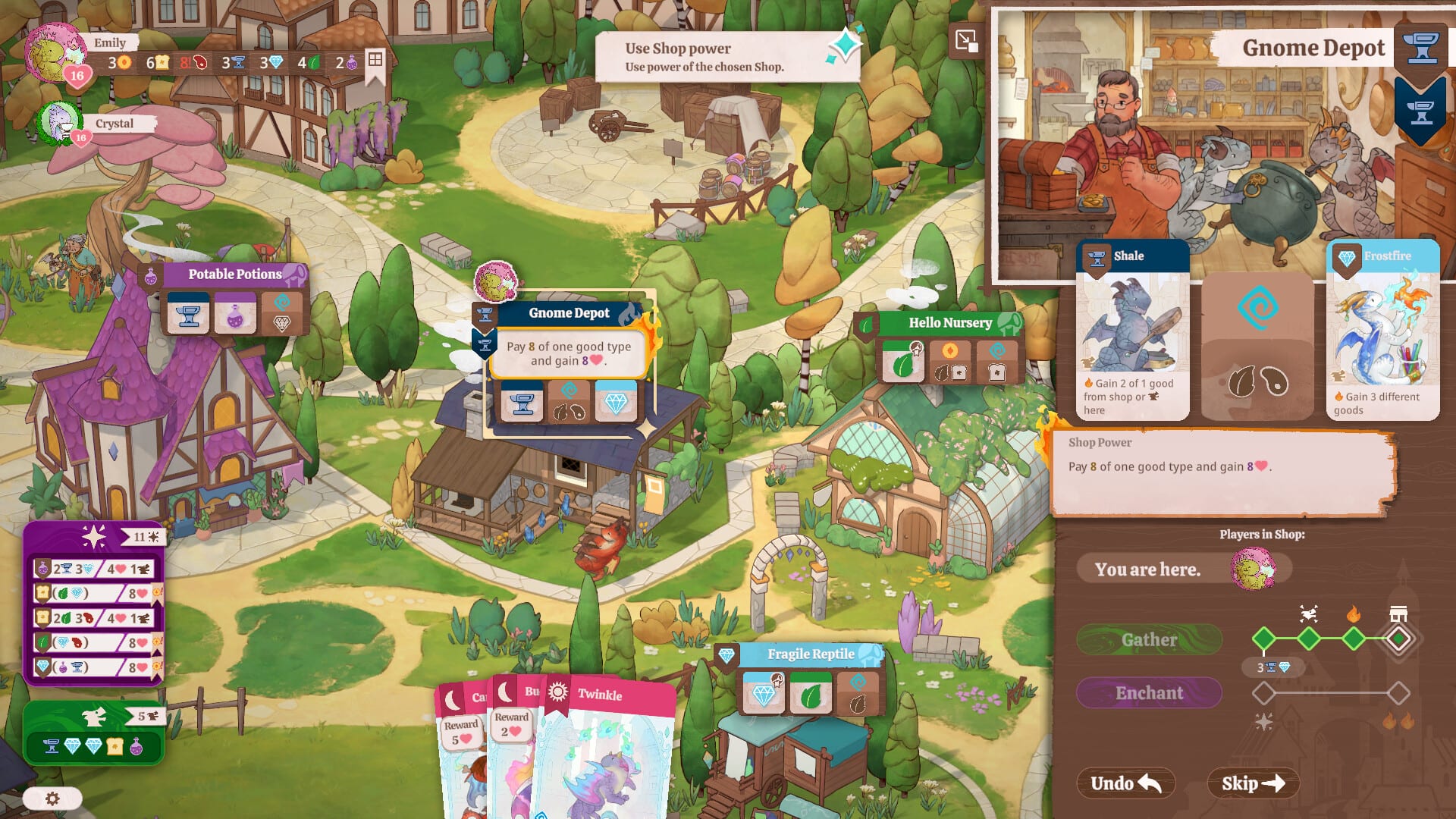
Flamecraft’s town is a ring of 30 shops shared by every Artisan Dragon, Fancy Dragon, and Companion. Monster Couch’s digital edition keeps the Cardboard Alchemy board-game rhythm: you never camp on one tile, you choose Gather or Enchant each visit, and you pay rivals who got there first. Goods are not abstract cubes—they are bread, meat, iron, crystal, plant, and potion, plus coins that act as wild goods and score at the end. Master the map with How to Play Flamecraft, then drill chains in How to Enchant.
One new shop every turn
On your turn you must visit a different shop than last turn—you cannot stay. That rule forces rotation around the town and makes route planning as important as recipes. Before you commit, scan who already occupies the tile: you owe one good or one coin to each other player already at that shop. Treat that payment as part of the action cost, especially in local multiplayer with up to five artisans on one screen.
Route mistakes show up as repeated entrance taxes on the same crowded bakery or forge. Use the Turn Planner to sketch two-hop paths so you are not paying three rivals every other round.
Gather at a shop
When you Gather, you pull goods from the shop type, from enchantments already tucked behind that shop, and from Artisan Dragons present who match the production. You may place an Artisan Dragon in a matching empty slot and collect its place reward. You may Fire Up one dragon’s ability—only one on a Gather turn. You may also use the shop ability printed on the tile.
Gather turns feed the six physical goods your roster expects. Pair production with Artisan Dragons so you know which shop types your workers unlock.
Enchant at a shop
When you Enchant, you pick a matching Enchantment from the display, pay its cost, and tuck the card behind that shop—at most three enchantments per shop. After paying, you may Fire Up all dragons at that shop, which is why enchant visits often spike reputation toward Master of Flamecraft. Timing those bursts against rivals is the subject of Enchantment Timing and How to Win in Flamecraft.
Enchantment slots are public information once tucked. Blocking a shop with three enchantments already stacked can deny an opponent’s finish line—see Combo Strategy for ethical denial versus self-sabotage.
The six goods and coins
| Good | Typical role |
|---|---|
| Bread | Bakery and food chains |
| Meat | Hearty production and tavern routes |
| Iron | Smithing and heavy craft |
| Crystal | High-value enchant inputs |
| Plant | Herbs and flexible gather |
| Potion | Alchemy and late enchant windows |
Coins are wild goods: they can stand in for missing types when paying costs, and they convert to end-game victory points alongside reputation. Hoarding coins feels safe but starves Fire Up if you never convert them into scored deliveries.
Track mixes on paper or with the Resource Checklist until the demo UI feels second nature.
Artisan dragons and matching slots
Each Artisan Dragon ties to goods and shop types. Placing one in a matching empty slot triggers its place reward, which is often the difference between a Gather that merely fills hands and a Gather that sets up next turn’s Enchant. Fancy Dragons rarely create these base goods; they amplify enchanted output. Companions sometimes help you reach a matching slot before someone else claims it.
Shop abilities and enchantment stacks
Every shop ability interacts differently with stacked enchantments—some double production, others discount enchant costs, others feed Fire Up thresholds. Read the tile once per session in the Becca Scott tutorial slice, then revisit after patches noted on Release Info.
Demo town versus full release
The demo on Steam, PS5, Xbox Series X|S, and Switch teaches the rotation, tax, Gather/Enchant split, and core goods. The full game remains upcoming—Switch lists September 17, 2026—with the same town size promise and planned online matchmaking alongside couch play. Do not assume every tabletop shop appears in the demo build; verify with Demo Review after major updates.
Study drills
- Play one demo run naming every good you gather aloud.
- Count entrance tax paid per round—if it exceeds two goods, fix routing.
- Enchant once with three stacks already on a shop to feel the Fire Up-all dragones rule.
- Finish by reading Beginner Tips with your shop notes beside the keyboard.
Related links
- Demo Walkthrough — district pacing in the free build.
- Solo Mode — lighthouse scenarios still use the same shop rules.
- Platforms & Demo — install links per device.
- Controls — confirm inputs before timed enchant picks in multiplayer.
Frequently Asked Questions
Quick answers for new Flamekeepers.
Can I stay on the same shop two turns in a row?
No. Each turn you must visit a new shop. Plan a route so you are not forced into expensive detours.
What do I pay when other players are at my shop?
Pay one good or one coin to each other player already at that shop before resolving Gather or Enchant.
How many enchantments can sit behind one shop?
At most three enchantments per shop. After tucking one, an Enchant turn lets you Fire Up all dragons there.
What are coins used for?
Coins count as wild goods for costs and also score as end-game victory points alongside reputation.