How to Play Flamecraft
Core rules for the digital cozy economy game—demo and full release.
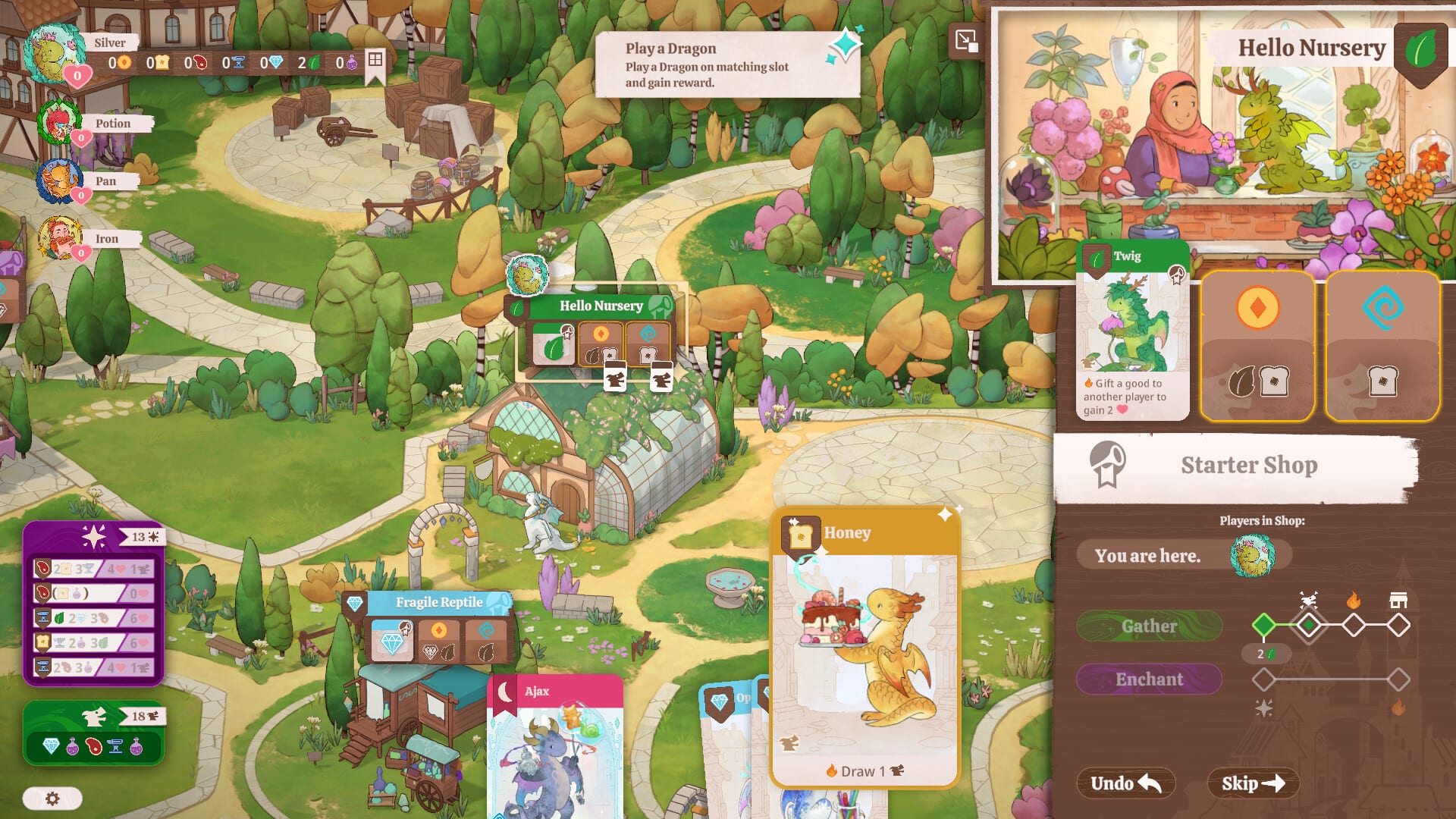
Flamecraft translates the board game by Cardboard Alchemy, published digitally by Monster Couch, into a dragon-powered town sim where every turn is a small puzzle about workers, goods, and fame. This guide explains the loop you will see in the free demo—with its Becca Scott narrated tutorial—and the same foundation the full game builds on when it launches (Coming soon on Steam; September 17, 2026 on Nintendo Switch at the time of writing).
Goal: reputation and Master of Flamecraft
You are not trying to bankrupt rivals in Flamecraft. You are racing along a reputation track to become Master of Flamecraft. Reputation comes from running shops well, delivering enchanted products, and timing Fire Up moments that convert your engine into a burst of public acclaim. Cash and resources are means to that end; the win condition is standing, not wallet size alone.
For endgame pacing and when to push reputation, pair this page with How to Win in Flamecraft after your first demo run.
Who plays: one to five artisans
Flamecraft supports 1–5 players. In local multiplayer, up to five people share one screen with pass-and-play turns. Solo mode adds a story framed around a lighthouse and scripted opposition so one person can learn without a group. The full release also plans online matchmaking for remote tables; that is separate from couch play—see Multiplayer in Flamecraft for mode details.
Your pieces: dragons and companions
Each player commands Artisan Dragons—workers you place on the town map—and recruits Fancy Dragons that grant powers tied to enchantment and shop types. Companions ride along as helpers with passive or triggered bonuses. Together they define how many actions you can take and which shops you can operate efficiently.
Dragon identities matter for long-term plans. After you know the verbs, skim the Strategy Hub and Fancy Dragon Tier to see which profiles community players favor for different strategies.
The town: thirty shops
The village offers 30 shops, each producing or transforming goods when a dragon visits. Shops are the board’s geography: distance, ownership, and upgrade timing determine whether you gather raw materials locally or ship finished enchantments across town. In the demo you explore a slice of this economy; the full game expands the same structure.
Use the Resource Checklist when learning recipes so you are not guessing which inputs a shop expects mid-turn.
Turn structure in plain terms
While exact UI labels match the digital tutorial, mentally group each round into phases:
- Place dragons on shop tiles you can reach and afford.
- Resolve shop actions—usually choosing Gather (pull resources from the environment or stockpiles) or Enchant (combine goods into higher-value products).
- Spend or bank resources for upgrades, Fancy Dragon hires, or preparation for Fire Up.
- Advance reputation when deliveries, events, or Fire Up resolve.
The demo tutorial walks these steps with voiceover; our Demo Walkthrough aligns chapter breaks with that flow so you can pause and read.
Gather versus Enchant
Gather keeps the engine fed. You need wood, herbs, metals, or whatever a shop’s card specifies before anything fancy happens. Enchant is where Flamecraft’s identity lives: turning mundane stacks into themed goods that score better and unlock combo chains across shops.
New players often over-gather and under-enchant, then wonder why reputation stalls. The fix is not hoarding—it is completing enchantment lines that feed Fire Up. Deep dive that split in How to Enchant in Flamecraft.
Fire Up
Fire Up is the dramatic step where prepared work becomes a reputation spike—think of it as your shop window moment when the town notices your craft. You typically need the right enchanted goods, sometimes a shop upgrade, and good timing relative to opponents’ turns.
Missing Fire Up windows is the most common beginner mistake. Watch when rivals fire and what they spent the prior round to set up.
Demo versus full game expectations
The demo is live on Steam, PS5, Xbox Series X|S, and Switch and teaches the core loop with guided scenarios. The full game adds breadth—more campaign context, expanded solo story, and planned online matchmaking alongside local multiplayer. Check platforms and demo for install links and release info for launch status.
Suggested first session
Play the narrated tutorial once without skipping, then replay a scenario trying to Enchant every other turn instead of default-gathering. Finish by reading How to Win so reputation swings make sense. If you prefer video, the embed on this page complements but does not replace hands-on placement practice.
Community and updates
When rules text or demo patches change, mechanics notes land in Release Info first. Browse the Dragons Hub once you outgrow beginner openings.
Frequently Asked Questions
Quick answers for new Flamekeepers.
What is the win condition in Flamecraft?
You win by reaching the top of the reputation track and becoming Master of Flamecraft, not by eliminating other players or only collecting money.
What is the difference between Gather and Enchant?
Gather collects raw or basic goods from shops and the environment. Enchant combines those goods into higher-value products that feed scoring and Fire Up.
Does the demo teach the full rule set?
The demo teaches core placement, Gather, Enchant, and Fire Up with a narrated tutorial. Some content and modes ship with the full release.
How many players can play at once?
Flamecraft supports 1–5 players. Local multiplayer fits up to five on one device; solo mode uses story and AI-style opposition.